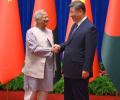
'It was the hostility of the Yunus regime that made India careful and wary of dealing with them.' 'They gradually backed off and lowered the noise, but the damage was done.' 'Their true colours had been exposed.'
He said that the two nations will have issues in the foreseeable future. However, there are ways of addressing those issues and what happened in 2020 was not the way to address those issues.

Engineering and construction major Larsen & Toubro (L&T) reported a 25 per cent rise in net profit attributable to the owners of the company for the January-March quarter of 2024-25, owing to higher revenues and an exceptional gain. For the quarter under review, L&T posted a consolidated net profit of Rs 5,497.3 crore, while revenue rose 10.9 per cent year-on-year (Y-o-Y) to Rs 74,392.28 crore.

Recognising the threat posed by outfits like the Al Qaeda, Lashkar-e-Tayiba and the Dawood Ibrahim network, India and the United States have agreed to deepen cooperation in fighting terrorism and asked Pakistan to bring to justice the 2008 Mumbai attack perpetrators.

An India-Japan joint statement said the two leaders expressed serious concern over the conflict and the unfolding humanitarian crisis in Ukraine.

India stressed that it is even more extraordinary for a country with a history of rigged elections to talk about political choices, that too in a democracy.

The government needs to answer the critical question of whether it has accepted any restrictions on its infrastructure creation activities, asserts Ajai Shukla.

In a significant departure from tradition, the United States has decided to host Prime Minister Narendra Modi by working out a "special gesture date" around the 69th Session of the United Nations General Assembly meeting that is scheduled to take place on September 26 in New York.

'The border deal offers a hedge for India against Trump's unpredictability when it comes to his approach to competition with China.'
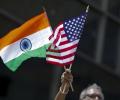
On June 27, the ministry of external affairs confirmed that the US postponed the 2+2 dialogue with India, which was scheduled to be held on July 6, due to "unavoidable reasons".

The two-plus-two dialogue will be held on Tuesday. A host of crucial bilateral, regional and global issues including China's efforts to expand influence in the Indo-Pacific region as well as its aggressive behaviour in eastern Ladakh is likely to figure in the talks.

Amid a row between China and the US-based search engine Google, Premier Wen Jiabao has said his country is looking forward to the strategic dialogue with Washington in May to resolve trade and currency disputes

India seeks to play a supportive role for a peaceful and stable region, Prime Minister Narendra Modi said on Monday as he embarked on a high-profile visit to Russia to hold summit talks with President Vladimir Putin amid the conflict in Ukraine.
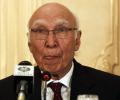
Pakistan on Thursday accused India of using the Pathankot terror attack as an "excuse" to derail the bilateral dialogue process and said that talks are the best way forward to resolve outstanding issues, including "mutual concerns" related to terrorism.

Prime Minister Narendra Modi on Monday briefed US President Joe Biden in a phone conversation on his visit to Ukraine and conveyed India's full support for the early return of peace to the region through dialogue and diplomacy.

Russian President Vladimir Putin on Tuesday thanked Prime Minister Narendra Modi for trying to help find a peaceful solution to the Ukraine crisis.
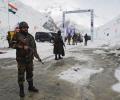
With Beijing remaining intransigent on the withdrawal of additional troops deployed by the People's Liberation Army (PLA) since the deadly border clash in 2020 in eastern Ladakh, India's bilateral ties with China remained frozen in 2023 with no forward movement on the horizon despite several rounds of diplomatic and military talks.

"We are waiting for our good friend Modi and best regards to him," the Russian media quoted Putin as saying in the meeting with Doval.

He also said that his country would continue to talk about the Kashmir issue "through channels that are acceptable" and prayed that "the issue is amicably resolved".

'We are confident that the US manufacturing industry will be able to take advantage of the US-India Investment Initiative to effectively support our goals of assisting in the development of three Indian cities -- Ajmer, Vishakhapatnam and Allahabad -- where the United States will be the lead partner,' Senators Warner and Cornyn told Obama.
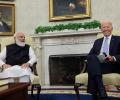
'The message that we intend to leave with at the end of this trip is one of real gratitude for the friendship and the close partnership that President Biden and Prime Minister Modi have enjoyed over the last four years, but also one of tremendous optimism because we see a lot of opportunity in the future.'
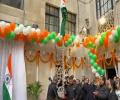
Leaders from around the world extended their greetings to India on its 76th Republic Day, emphasizing the importance of bilateral relations and expressing hope for a stronger future. The Indian diaspora across the globe celebrated the occasion with enthusiasm at Indian missions abroad, where the national tri-colour was unfurled, accompanied by cultural performances and patriotic fervour. The celebrations highlighted the strong bonds of friendship and cooperation between India and its global partners.

Politicians, bureaucrats hold different opinions about the delaying of the 2+2 summit.

"The political stars never quite aligned but a solution similar to the Northern Ireland Good Friday Agreement, with a soft border allowing locals to travel freely from one part of Kashmir to the other, will have to be the outcome of any peaceful solution," he noted.

US Secretary of State Micheal Pompeo and Secretary of Defence James Mattis will travel to New Delhi next month for the 2+2 dialogue.
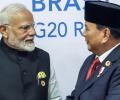
India is trying hard to erase Indonesia's wariness about New Delhi, building security cooperation in the Indian Ocean and Pacific Ocean. If Indonesia decides to buy the Brahmos missile, it would further strengthen relations between the world's most populous nation and the most populous Islamic country.

After her meeting with External Affairs Minister S M Krishna, US Secretary of State said that Indo-US strategic partnership can be upped beyond 3.0 level that she had envisaged. Aziz Haniffa reports

US envoy Eric Garcetti on Thursday said he respects that India likes its "strategic autonomy", but in times of conflict, there is no such thing as strategic autonomy, even as he pitched for forging a stronger partnership between New Delhi and Washington.

'We condemn recent illicit missile launches in the region that violate UN Security Council resolutions. We express serious concern over recent dangerous and aggressive actions in the maritime domain. We seek a region where no country dominates and no country is dominated one where all countries are free from coercion, and can exercise their agency to determine their futures,' the declaration said.

India and China on Tuesday discussed the recent spate of incursions and ways to maintain peace and tranquility along the Line of Actual Control in the border areas.

The annual Quad summit at President Joe Biden's hometown Wilmington is expected to roll out a series of new initiatives to boost cooperation in the Indo-Pacific and explore ways to find peaceful solutions to the conflicts in Ukraine and Gaza.
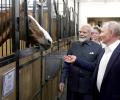
India has been stoutly defending its "special and privileged strategic partnership" with Russia and maintained the momentum in the ties notwithstanding the Ukraine conflict.

Ahead of his much-anticipated visit to conflict-torn Ukraine, Prime Minister Narendra Modi on Thursday said India firmly believes that no problem can be solved on the battlefield and it is ready to extend all possible cooperation for the restoration of peace and stability in the region.

When questioned on recent efforts by the US to bring up issues against India at the World Trade Organization, most recently to thwart India's efforts to market generic drugs, Rao reiterated the 'candour in the dialogue' both countries have which had helped maintain a balance, eschewing any extreme decisions.
Focusing on five key areas including security cooperation and trade, United States Secretary of State Hillary Clinton on Wednesday said India and the United States are moving to forge a new and more mature phase of ties, as the 3rd Indo-US strategic dialogue kicked off in Washington, DC.
The United States believes India has the required institutional capacity to become a global power and sees a growing strategic convergence between the two nations, a top administration official has said ahead of next week's India-US strategic dialogue.
With the Indo-US civilian nuclear deal in a limbo in the wake of the Indian Parliament's nuclear liability law, the Barack Obama administration has asserted that complete implementation of the accord is imperative for the full transformation of the relationship.
Union Finance Minister Pranab Mukherjee met United States Secretary of State Hillary Clinton and National Security Adviser Tom Donilon to discuss bilateral and regional issues.

America had postponed the much-awaited dialogue due to "unavoidable reasons" last month.
United States' Assistant Secretary Robert Blake on Wednesday marked the beginning of the US-India Cabinet-level Strategic Dialogue in Washington, DC, and discussed bilateral ties and issues like counter- terrorism, education, agriculture, trade and climate change. In his opening message, Blake said that US President Barack Obama feels that it's very much in American strategic interests to help advance the growth of India on the world stage.
